Last Updated: 30 October 2026
Quick Summary
Choosing the right renovation materials means matching each product's properties to how the room is actually used, rather than picking what looks best in a showroom. Start with the room's main stresses, check performance ratings before appearance, and compare options on whole-life cost over a realistic holding period.
- Build a room-by-room schedule listing each room's stresses and the performance rating you need before visiting a supplier.
- Bathrooms need tanking beneath tiles and a suitable slip rating on the floor.
- Compare materials on annual cost over ten or fifteen years, not price per square metre.
- Confirm lead times in writing and order tiles, flooring or bricks from one batch.
- Order the measured quantity plus a cutting and breakage allowance, keeping surplus for future repairs.
Table of Contents
- Start With the Room, Not the Showroom
- Match Material Properties to How Each Room Is Used
- Durability, Lifespan and Whole-Life Cost
- Sustainable Building Materials UK Homeowners Can Specify With Confidence
- Building Regulations for Home Improvements and What They Mean for Material Choice
- Renovation Material Procurement Tips: Lead Times, Quantities and Sourcing
- Material Compatibility and Installation Requirements
- Book a Material Specification Review With FMT Construction
- Frequently Asked Questions
Start With the Room, Not the Showroom
A useful material selection guide works room by room, matches material properties to real use, and highlights costs that can appear after installation.
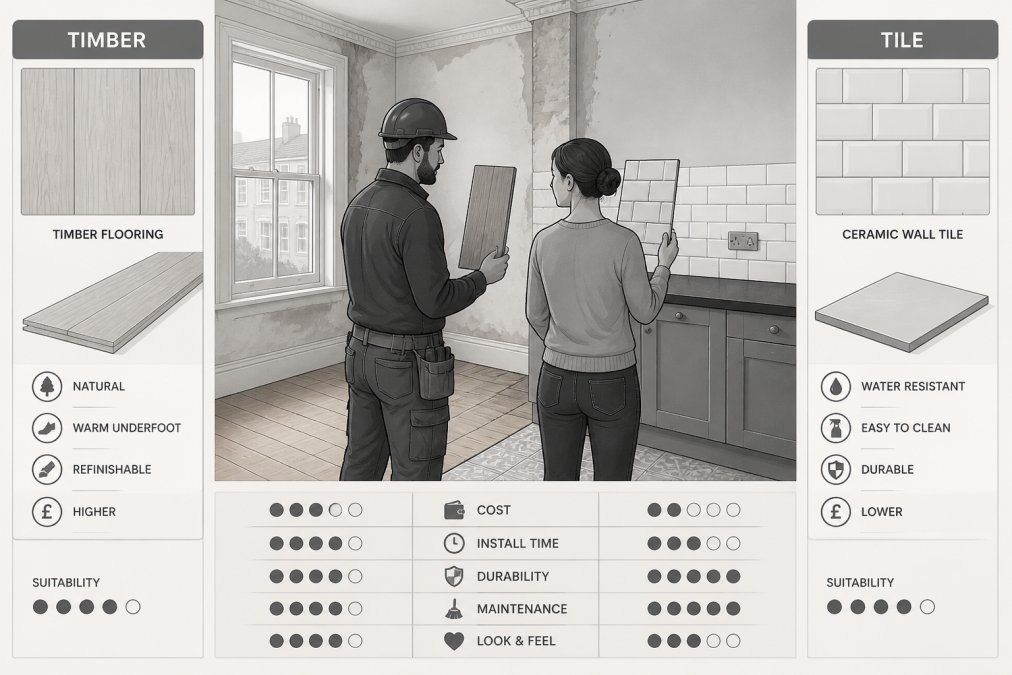
A renovation material is any building product specified for a home improvement project, from structural timber and steel to tiles, worktops, flooring and finishes.
If you are thinking room by room, it helps to see how a full refurbishment pulls those choices together.
Match Material Properties to How Each Room Is Used
Material properties matter more than material trends. A kitchen worktop, a bathroom floor and a bedroom wall take completely different punishment, so the specification should change with the room, not stay fixed across the house. Most guides stop at that principle; the practical value is in applying it room by room.
Kitchens
Kitchens combine heat, grease, knife impact and frequent cleaning. Prioritise heat resistance and repairability over pure looks. Quartz and solid surface worktops resist staining and can be refinished; granite is heat-resistant but can chip and is hard to repair on site. Solid timber worktops need regular oiling and are vulnerable around sinks. For flooring, porcelain tile and LVT cope well with spills, while solid timber needs prompt mopping and will show wear in front of the sink and hob.
Bathrooms
Bathrooms combine constant moisture, temperature swings and slip risk. Waterproofing and slip resistance come first. Use a tanking system beneath tiles in wet areas, and choose tiles with a suitable slip rating for the floor, smooth polished tiles are a poor choice underfoot even when they look premium. LVT rated for wet rooms is a practical alternative to tile, but check the manufacturer's suitability for bathrooms and underfloor heating.
Hallways and Living Areas
Hallways and living areas take foot traffic and wear. Wear resistance and ease of repair win. Engineered timber, LVT and porcelain tile all perform well; solid timber can be sanded and refinished but is softer under heavy traffic. In living areas, consider how the material will age, a finish that patinas gracefully often looks better in year ten than one that chips.
Bedrooms
Bedrooms prioritise comfort and indoor air quality. Low-VOC finishes matter more than toughness. Carpet remains popular for acoustic comfort, but check the underlay and adhesive for emissions. Engineered timber and cork are good alternatives where a hard floor is preferred. Specify low-VOC paints and sealants, and ventilate well after installation.
Exteriors and Utility Spaces
Exterior materials must resist frost, UV and rain. Paving, cladding and external finishes should be rated for external use, and timber should be treated or naturally durable. Utility spaces such as porches and conservatories need materials that cope with temperature swings without warping or condensation damage.
Moisture, Temperature and Wear Resistance by Room
Moisture resistance is the single most common failure point in renovation materials. A flooring product rated for a dry living room will swell, lift or stain in a bathroom, no matter how well it is installed. Temperature resistance matters wherever there is underfloor heating or a shower, check the product's declared compatibility with underfloor heating before you buy. Wear resistance decides how a surface looks after five years of daily use; look for the manufacturer's wear rating rather than relying on the showroom sample.
Each room imposes different stresses, so the specification should change with the room rather than stay fixed across the house.
| Room | Main stresses | What to prioritise |
|---|---|---|
| Kitchens | Heat, grease, knife impact, frequent cleaning | Heat resistance and repairability over pure looks |
| Bathrooms | Constant moisture, temperature swings, slip risk | Waterproofing and slip resistance come first |
| Hallways and living areas | Foot traffic and wear | Wear resistance and ease of repair |
| Bedrooms | Comfort and indoor air quality | Low-VOC finishes matter more than toughness |
| Exteriors and utility spaces | Frost, UV, rain, temperature swings | Materials rated for external use; treated or durable timber |
Durability, Lifespan and Whole-Life Cost
Durability is not the same as quality, and lifespan is not the same as price. The cheapest material per square metre often costs the most over the life of the renovation once repair and replacement are counted.
Whole-life cost means the purchase price plus installation, maintenance, repair and eventual replacement, divided across the years the material actually serves. A simple way to compare two options is to add those costs over a realistic holding period, say ten or fifteen years, and divide by the years of service.
Typical Lifespan and Maintenance Intervals
Exact figures vary by product, substrate and use, so always check the manufacturer's declared service life and warranty terms. As a working guide for residential projects, most practitioners find the following patterns hold:
- Solid timber flooring: decades of service if sanded and refinished periodically; sensitive to moisture and requires acclimatisation before fitting.
- Engineered timber and laminate: a long service life in dry rooms, but laminate is not suitable for wet areas and engineered boards have a limited number of sanding cycles.
- Porcelain and ceramic tiles: very long-lived and low-maintenance, but installation quality and substrate preparation determine whether they stay that way.
A Worked Comparison
Take two bathroom floor options. Pricing depends on product grade, quantity, dates and delivery, so the most reliable comparison comes from itemised quotes. Ask for quotes that show the material, adhesive, grout and labour separately, then run the whole-life comparison on your own numbers rather than showroom prices.
Before committing, ask what the quotation actually includes. Our guide to avoiding hidden costs in home renovations explains what building quotes should include and how to compare them fairly. A building quote should set out clearly what it covers so that two quotes can be compared fairly.
Maintenance: The Quiet Cost
Maintenance is the line most often left out of a budget. Sealing stone, re-oiling timber, re-grouting tiles and touching up painted finishes all carry a cost in materials and time. A material that needs resealing every year quietly drains the budget, while a material that needs nothing beyond routine cleaning may justify a higher purchase price. Build the maintenance interval into your decision, not just the purchase price.
Sustainable Building Materials UK Homeowners Can Specify With Confidence
Sustainable building materials are products specified for their lower environmental impact, whether through responsibly sourced timber, recycled content, reclaimed stock or low-VOC finishes. The practical test is simple: can you evidence the claim?
- Responsibly sourced timber: ask for certification paperwork, not a verbal assurance.
- Recycled and reclaimed materials: confirm structural suitability before reuse.
- Low-VOC finishes: specify these in bedrooms and children's rooms first, where indoor air quality matters most.
Eco-friendly renovation is not a premium add-on. It is a specification decision made at the same time as every other one, and it should appear in the written quotation so it can be checked on delivery.
Building Regulations for Home Improvements and What They Mean for Material Choice
Building regulations for home improvements directly restrict what materials you can use and how they must be installed, particularly around fire safety, thermal performance, structural integrity and ventilation.
This is where many guides go quiet. In practice, a material that is perfectly legal in one application may fail the requirement in another.
The frequently asked questions we get cover how regulations affect material and specification choices in plain terms.
Renovation Material Procurement Tips: Lead Times, Quantities and Sourcing
Procurement is where good material choices fail. Lead times, minimum order quantities and batch variation cause more delays on residential projects than any design decision.
Good procurement practice comes down to three moves:
- Confirm lead times in writing before the programme is fixed.
- Order from one batch where tiles, flooring or bricks must match.
- Check availability early for imported or made-to-order products.
Sourcing also means checking who stands behind the product, since a supplier with a solid track record is worth more than a marginally lower price from an unknown source.
Ordering Quantities and Allowances
Ordering quantities should include a cutting and breakage allowance, not just the measured area. Tiles, flooring and bricks all need spare stock for cuts, future repairs and batch matching.
A practical rule is to order the measured quantity plus a sensible allowance, and to keep any surplus stored for future repairs.
Material Compatibility and Installation Requirements
Material compatibility is the requirement that specified products work together without causing failure, and installation requirements are the conditions each product needs to perform as intended.
Some combinations simply do not belong together.
Where a project involves knock-throughs or load-bearing changes, the material specification has to work with the structure. See how structural alterations across Surrey are handled safely to building regs.
Book a Material Specification Review With FMT Construction
The challenge with choosing the right renovation materials is that every decision interlocks: the room's use sets the properties, the properties set the cost, and the cost has to survive procurement and installation.
FMT Construction brings over 35 years of practical experience, expertise in complex structural alterations, and bespoke construction solutions. The aim is high-quality finishes and long-lasting results.
Get started with FMT Construction to discuss your renovation materials. Contact us to arrange a discussion.
Frequently Asked Questions
What are the most durable materials for home renovations?
Durability depends on the room as much as the material. In wet areas, porcelain tiles and sealed natural stone outperform laminate and engineered timber, which swell when water sits on them. For floors in hallways and kitchens, solid or engineered oak with a hard lacquer wears well and can be sanded back. Worktops in quartz or granite resist scratches and heat better than solid timber. Ask for the manufacturer's wear rating and warranty terms, then match them to the traffic and moisture the room will actually see.
How do building regulations for home improvements influence material selection?
Building regulations for home improvements set minimum standards that rule some materials in or out. Part L sets thermal performance targets, so extensions and loft conversions need insulation with a declared U-value. Part B governs fire safety, which affects linings, doors and surfaces in circulation areas. Part F covers ventilation, which matters when you choose airtight finishes. Your building control body will ask for product data, so specify materials with clear certification rather than relying on a merchant's verbal assurance.
Are sustainable building materials UK homeowners choose worth the investment?
Often, yes, but judge them on whole-life performance rather than the label. Responsibly sourced timber, reclaimed brick and low-VOC finishes can cost more upfront, yet they frequently last longer and need less maintenance, which lowers the cost per year of use. Some also help with planning and energy assessments. Check for third-party certification such as FSC for timber and ask for VOC content on paints and adhesives, particularly if anyone in the household has respiratory sensitivities.
Should I source my own renovation materials or let my contractor handle it?
Both routes work, but they carry different risks. Sourcing yourself can save on the unit price, yet you own the lead times, delivery slots, damage and shortfalls, and a contractor cannot warranty installation faults caused by faulty goods they did not supply. Letting your contractor handle procurement usually gives you trade accounts, coordinated deliveries and one point of accountability. If you want to buy certain items yourself, agree in writing which party is responsible for quantities, storage and replacements before work starts.