Last Updated: November 2, 2026
Quick Summary
To find reliable Surrey builders, check their references, insurance and company details before you compare quotes, and then compare them on the same written brief. Ask for each builder's public liability certificate and employers' liability cover, verify any trade memberships directly, and get a written contract that sets out payments, variations and warranties before work starts.
- Ask past clients similar to your project about on-time completion, final costs and how problems were handled.
- Check public liability and, if the builder has employees, employers' liability insurance certificates and their expiry dates.
- Verify trade memberships directly with the organisation rather than relying on logos or screenshots.
- Normalise quotes onto one schedule and compare exclusions, payment schedules and programmes, not just totals.
- Agree payments tied to completed stages and get variations and warranties written into the contract.
Table of Contents
- Why Finding a Reliable Builder in Surrey Takes More Than a Search
- Questions to Ask a Builder Before Hiring
- How to Check a Builder's References
- Verifying Insurance, Trade Membership and Qualifications
- How to Compare Builders' Quotes Side by Side
- What to Include in a Building Contract
- Warning Signs of an Unreliable Builder and How to Avoid Disputes
- Booking a Free Consultation with FMT Construction
- Frequently Asked Questions
Why Finding a Reliable Builder in Surrey Takes More Than a Search
Most homeowners start with a quick search and a handful of phone calls. That approach often leads to a shortlist of builders who look similar on paper and behave very differently once the work starts. Knowing how to find reliable Surrey builders means looking past adverts and asking the right questions before a single brick is moved.
The projects that run smoothly usually share one thing: the client did their homework before signing anything. The projects that run into trouble often skipped it.
A common mistake is treating the lowest quote as the best value. A cheap price can hide missing items, vague scope or a builder who has not allowed for the unexpected. This guide covers how to check a builder properly, from their references and paperwork through to the contract you sign.
Questions to Ask a Builder Before Hiring
A good first conversation tells you more than a brochure. Ask how long the builder has worked on projects like yours, and whether they have completed work in your area. Ask who will be on site day to day, and who you should contact if something goes wrong.
Ask how they price their work and what is included. Clarify how they handle unexpected findings, such as hidden structural problems behind walls. Many disputes start here, because nobody agreed in advance how extra costs would be approved.
Finally, ask about the timeline. A realistic builder will explain the stages of the job and where delays commonly happen. A builder who promises an exact finish date without caveats deserves some scepticism.
How to Check a Builder's References
References are one of the most useful checks available to you. Ask for contact details of past clients whose projects were similar to yours in size and type. Speak to them directly and ask specific questions.
Useful questions include whether the work finished on time, whether the final bill matched the quote, and how the builder handled problems. Ask whether the client would hire the builder again. Pay attention to hesitation as much as to praise.
It also helps to visit a completed project if the client agrees. Look at the finish of joinery, the quality of plastering and how the site was kept during the works. These details reveal workmanship far better than a glossy portfolio.
Verifying Insurance, Trade Membership and Qualifications
Asking for paperwork is only half the job. The other half is checking it independently, because a logo on a van or a PDF attached to an email proves very little on its own. Work through the following checks before you sign anything, and keep copies of what you find.
Public liability insurance. Ask for the current certificate and read it rather than glancing at it. Check the policyholder name matches the business you are hiring, the cover is still in date, and the level of cover is sensible for the size of your project.
Employers' liability insurance. If the builder employs anyone, even one labourer, they are legally required to hold employers' liability insurance (Employers' Liability (Compulsory Insurance) Act 1969). Ask to see the certificate. A sole trader with no employees will not have this, which is fine, but a firm with a crew that cannot produce it is a warning sign.
Trade memberships. Trade bodies and competent-person schemes are useful, but only if you verify membership directly. Note the membership number and check it on the organisation's own website or by phone. Do not rely on a screenshot, a badge image or a PDF that could be out of date.
Qualifications for specialist work. Ask any builder you hire to confirm the registration of anyone carrying out gas, electrical or structural work, and check those registrations with the relevant register or body. Do not accept "we've done lots of these" as a substitute for a registration number you can check.
Trading history and address. Ask for the business's full legal name, company number if it is a limited company, and a trading address. You can check a company's status and filing history on the Companies House website for free (Get information about a company).
Building control and planning responsibilities. Ask the builder how they will handle building control inspections and who will pay the fees. For projects that need planning permission, confirm in writing who is submitting the application and who is responsible for any conditions attached to it. Your local planning authority can confirm what is needed for your address, and building control can confirm which inspections apply.
If a builder cannot or will not supply any of these items, treat that as information rather than an inconvenience. Reliable builders expect to be checked and will usually make the process easy.
How to Compare Builders' Quotes Side by Side
A stack of quotes is not a comparison until you have forced them onto the same footing. The aim is to remove anything that makes one quote look cheaper for reasons that have nothing to do with price: different scope, different assumptions, different payment terms or different exclusions. Work through the following steps in order.
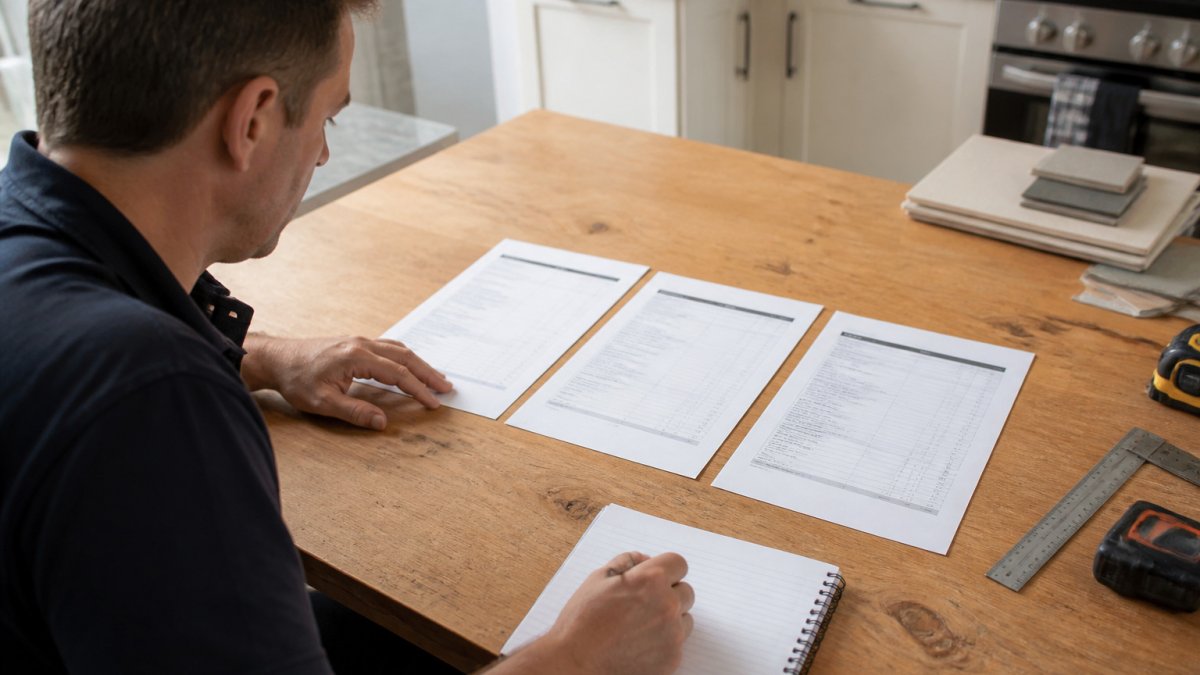
1. Fix the brief before you ask for prices. Write a single scope document, drawings, specification, room-by-room schedule of works and any known constraints, and send the same version to every builder. Ask each one to quote against that document and to list any assumptions they have made.
2. Normalise the quotes into a single schedule. Build a spreadsheet with one row per work item and one column per builder. Include preliminaries (site setup, welfare, skips, scaffolding), demolition, structural work, first and second fix, finishes, decoration, external works, building control fees, professional fees and VAT.
3. Compare the exclusions, not just the inclusions. The cheapest quote is often the one with the longest list of things it does not cover. Look specifically for scaffolding, skip hire, waste removal, making good after trades, decorating, kitchen and bathroom supply, building control fees, party wall fees and VAT.
4. Compare payment schedules. A quote is not just a total; it is a cash-flow plan. Ask for the proposed stage payments and check that each payment is tied to completed work you can inspect.
5. Compare programmes and completion dates. Ask each builder for a simple programme showing start date, key milestones and completion. Check whether the dates are fixed or subject to caveats such as planning, party wall awards or material lead times.
6. Compare variations and contingency. Ask how each builder prices changes once work has started: day rates, markup on materials, and how approval is documented. Check whether a contingency allowance is included and how it is drawn down.
7. Compare warranty and aftercare. Ask what guarantee each builder offers on workmanship, how long it lasts, what it covers and how a claim is made. Check whether the guarantee is backed by the builder, an insurer or a scheme.
| Check | What to look for |
|---|---|
| Scope | Same written brief quoted by every builder |
| Preliminaries | Scaffolding, skips, welfare, site setup |
| Exclusions | Listed explicitly, not left blank |
| Provisional sums | Stated and explained, not hidden |
| Payment schedule | Stage payments tied to completed work |
| Retention | Held back until snagging is done |
| Programme | Start, milestones and completion with caveats |
| Variations | Day rates and approval process in writing |
| Warranty | Length, scope and claims route |
| VAT | Confirmed as included or additional |
Pricing depends on size, specification, access and site conditions, so for current prices or a quote, please contact FMT Construction directly. Ask for itemised written quotes against the same brief, then compare the normalised schedules rather than the headline totals. If one quote is dramatically lower than the rest, ask the builder to explain what they have assumed and what they have left out before you treat it as good value.
What to Include in a Building Contract
A written contract protects both sides. It should name both parties, describe the work in detail and state the agreed price. Include the start date, expected completion date and what happens if the schedule slips.
The contract should set out the payment schedule. Payments tied to completed stages are safer than large sums paid upfront. Make sure the contract explains how variations are priced and approved before work changes.
Also check that the contract covers guarantees and warranties, responsibility for materials, and how disputes will be resolved. Keep a signed copy somewhere safe. If anything in the document is unclear, ask for it to be changed before you sign.
Warning Signs of an Unreliable Builder and How to Avoid Disputes
Several warning signs appear again and again in troubled projects. Be cautious of a builder who demands a large deposit before any paperwork is agreed. Be wary of pressure to sign quickly or to avoid getting a second quote.
Other red flags include reluctance to provide references or insurance details, no fixed address, cash-only requests and vague answers about timescales. A builder who avoids written scope is likely to create disputes later.
Preventing disputes comes down to clarity. Agree in writing how extra costs will be approved, keep records of all instructions and photograph the work at each stage.
Booking a Free Consultation with FMT Construction
If you are planning a new build, extension or renovation in Surrey, we are happy to talk through your project. Contact FMT Construction to discuss your project and request a quote.
Call us to discuss your project.
Frequently Asked Questions
How do you know if a builder is good?
Look for evidence rather than promises. Ask for recent projects similar to yours, speak to at least two past clients, check that the builder holds appropriate insurance and trade membership, and confirm they will provide a written contract with a clear scope of work. A good builder answers questions directly, gives a detailed written quote, and is willing to show you completed work in person. Be cautious of anyone who pressures you to sign quickly or asks for a large deposit before work begins.
What should a building quote include?
A proper building quote should set out the full scope of work, materials, labour, timescales, payment stages, VAT treatment and any allowances for unforeseen issues. It should also state what is excluded, such as building control fees or redecoration. Vague lump sums with no breakdown make comparison difficult. Ask each builder to quote against the same specification so you are comparing like with like, and check whether the price includes waste removal and making good after the work.
How can I check whether a builder has suitable insurance?
Ask for a copy of their public liability insurance certificate and check that the cover is current and adequate for the work you need. Employers' liability insurance is also required in the UK if the builder employs staff. Confirm the policy dates and contact the insurer if anything looks unclear. Keep a copy on file, as you may need it if something goes wrong on site.
Should I use a written contract when hiring a builder?
Yes. A written contract protects both parties and sets out the scope of work, price, payment schedule, start and completion dates, variation procedures and how disputes will be handled. Verbal agreements are very difficult to enforce if the project goes wrong. Read the contract carefully before signing and make sure every change to the original specification is recorded in writing.